Daily · Post Line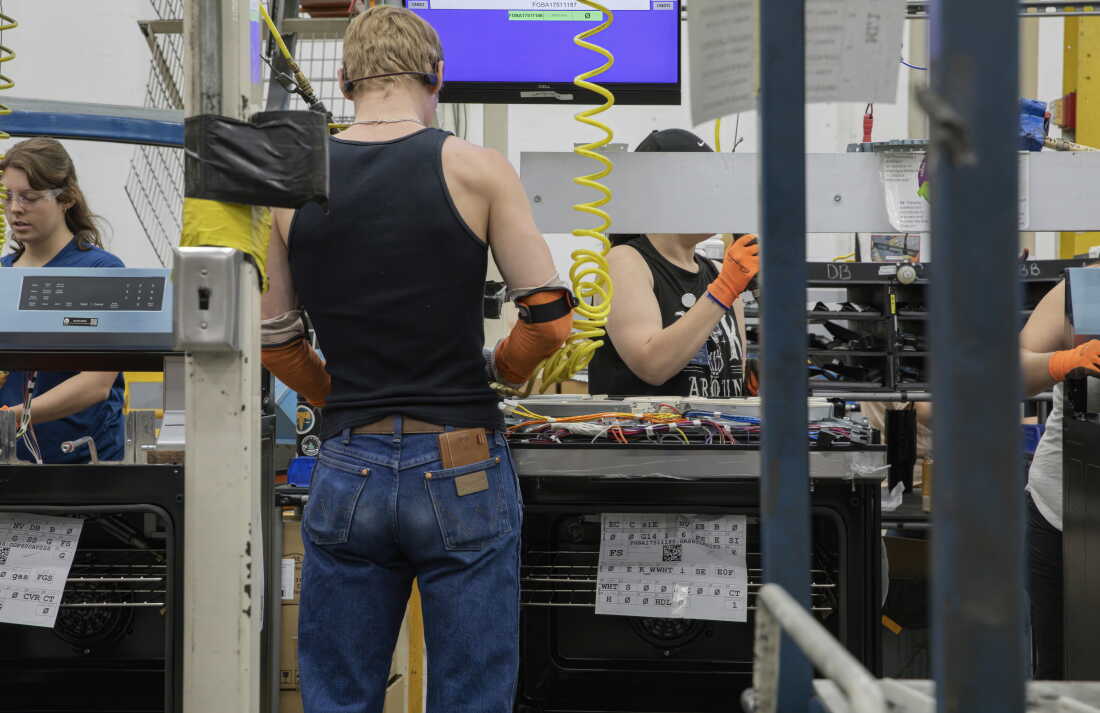
The assembly lines at GE Appliances' cooking appliance plant in LaFayette, Ga., have camera systems trained to detect errors. Julie Holder for NPR hide caption toggle caption Julie Holder for NPR Sign up for alerts on breaking news and exclusive reporting from NPR LAFAYETTE, Ga. — Inside Roper Corporation, a GE Appliances-owned plant in rural northwest Georgia, autonomous vehicles deliver parts to assembly lines. Robots attach glass cooktops to metal frames.
And deployed throughout are AI-powered cameras and sensors, trained to catch mistakes. "We have these things everywhere out here," says Tony Gabbert, the plant's director of manufacturing operations. If a camera spots an anomaly — the wrong gasket installed on an oven, for example — the system will shut that part of the line down and start playing loud music.
"If you hear AC/DC, you know to come running down here," says Gabbert. "The quicker we know what the problem is, the quicker we can fix it." Pressure to be perfect Tony Gabbert is the plant's director of manufacturing operations. He says AI-powered quality control systems are critical to ensuring they catch errors early and solve them quickly.
Julie Holder for NPR hide caption toggle caption Julie Holder for NPR Today, American factories are under extraordinary pressure to perform perfectly. They must turn out flawless products, efficiently, in order to compete with imports from rivals overseas. It used to be up to people to achieve good results.
Now, manufacturers are leaning heavily into advanced technology and artificial intelligence to up their game. The goal at GE Appliances has always been to minimize errors, equipment downtime and scrap — and to ensure every appliance produced passes inspection and gets sent out to the consumer, problem-free. Now, with AI bringing its analytical prowess to troubleshooting, perfection seems tantalizingly within reach.
"We're not shooting for 97. We want to run 100 every day," says Gabbert, referring to a performance metric used in manufacturing. Already, the gains made are significant.
GE Appliances' vice president of manufacturing Bill Good estimates the company saves between $1.5 to $2 million per year with every percentage point of improvement. Data-driven transformation Using AI's analytical skills to help identify and troubleshoot problems, GE Appliances feels closer to minimizing errors down to zero. Julie Holder for NPR hide caption toggle caption Julie Holder for NPR GE Appliances has worked on collecting data through cameras and sensors for more than a decade.
With millions of lines of data now generated every day, the company's data platform Brilliant Factory can provide a real-time view into how each of its nine major appliance plants is running, down to the workstation. That means from company headquarters in Louisville, Ky., Good can see which machines are down and why, how many appliances are going to the repair bay and why, which parts are getting scrapped and how much that scrap is costing the company. "In the old days, I would call my plant manager, and I'd say 'How you running today?'" he says.
"Now I'll call them and say 'Why are you running so poorly?'" As powerful as visualizing that data is, having AI analyze the data and figure out where problems lie has been transformative, Good says. Plant managers can now start their days with AI-generated reports on not just where there might be problems, but how to solve them. AI will flag if the data shows that a motor is running hot, a sign it may soon give out.
The plant can then schedule a repair and avoid an unexpected and costly breakdown. Halting just one assembly line can cost the company between $300 and $500 per minute , Good says. "The name of the game in manufacturing is speed — speed at which you see the problem, speed at which you solve the problem," he says.
"Literally, minutes matter." 'It can outthink me' GE Appliances uses automated vehicles to deliver parts to assembly lines. Julie Holder for NPR hide caption toggle caption Julie Holder for NPR Good says AI has shrunk the gap between manufacturing veterans like him, who have seen every problem in the book, and those who may only have five years on the job. "It can outthink me," says Good, who's been in manufacturing for nearly 40 years.
Still, he doesn't worry that AI will replace him. "At least in the foreseeable future, I don't see AI replacing large populations of humans," he says. In fact, the way he sees it, AI is enabling GE Appliances to manufacture in the U.S.
The more efficient they are, the better positioned they are to compete with factories overseas that can pay their workers lower wages. GE Appliances, which in 2016 was acquired by the Chinese conglomerate Haier, recently added 600 jobs in Georgia as part of a $180 million expansion. The company has started using AI to optimize staffing.
Currently, if they find they don't need as many workers in one part of the plant, they'll move them to other tasks. They're also using AI to forecast market demand. This allows them to make last-minute decisions about what products to make on any given week.
Good says all of this is helping GE Appliances thrive despite the cutthroat competition. "You have to be faster, better, more flexible. That's the only thing that neutralizes the threat," he says.
Source: NPR