Daily · Post Line
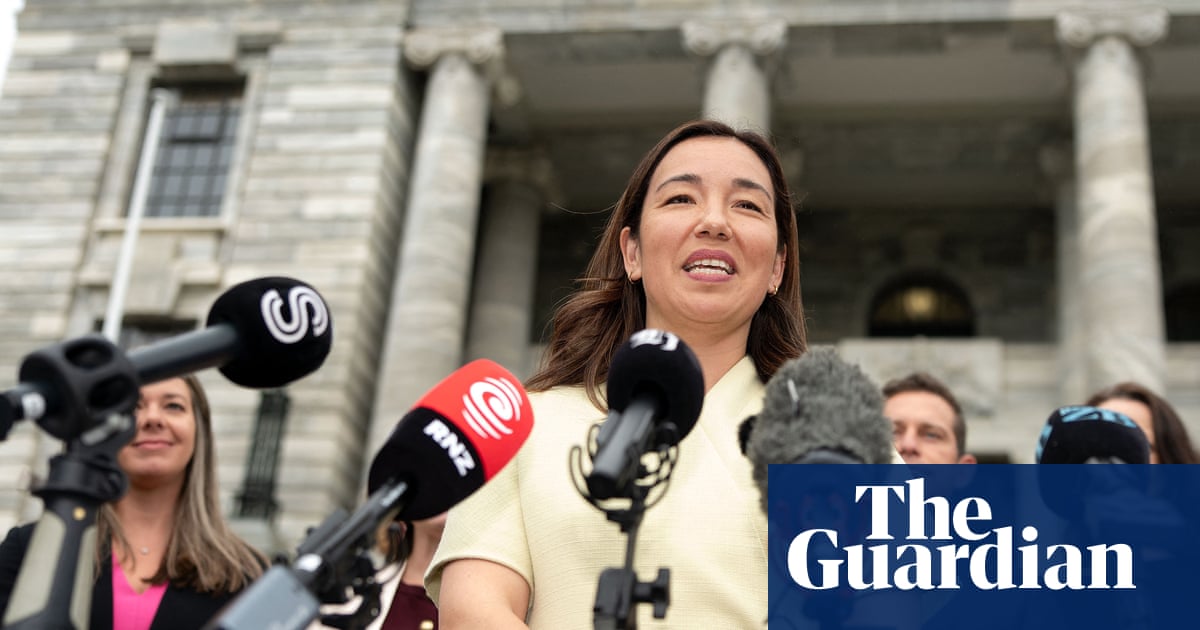
A history-making centrist party that could decide the fate of New Zealand’s next government has taken aim at global populism on its first day in parliament, as New Zealand reckons with the aftermath of an uncertain general election. A nail-biting election failed to hand either the incumbent rightwing coalition or opposition left bloc a strong winning hand on Saturday. New Zealanders will now need to wait until 27 November for the final result, which includes the addition of about 400,000 “special votes” – those cast overseas or outside the voter’s electorate.
The Opportunity party , led by businesswoman Qiulae Wong, secured 5.9% of the party votes, clearing the hurdle to enter parliament, and becoming the first new party not born of an existing MP, or party, to enter parliament since the formation of New Zealand’s mixed-member proportional (MMP) electoral system in 1996. Wong, who is of Chinese and European descent, also becomes the first leader of a party who has Asian ethnicity. With the left and right blocs separated by just a few seats, after the official results are released, Opportunity could be in a position to decide who governs.
From the steps of parliament on Monday, Wong said it was “a huge day” for the party, whose nearly 150,000 supporters wanted a more pragmatic approach to politics. “We’ve seen that populism doesn’t deliver results,” she said. “It is paper thin, it doesn’t have substance around taking countries forward.
So it’s really encouraging to have had that support.” Opportunity will negotiate first with the party that secures the highest number of seats, but its vision for a low-emissions future, and an inclusive New Zealand, will drive its final decision. Its five bottom-line issues include action on New Zealand’s supermarket duopoly, capping political donations, a 10-year cross-party plan for health, ending bottom trawling in the fishing industry and strengthening New Zealand’s climate commitments. “Ultimately, we need to align on that future vision for New Zealand,” Wong said.
New Zealand prime minister and National party leader, Christopher Luxon, speaking to media on 9 November 2026. Photograph: Bianca de Marchi/EPA Leader of the centre-right National party, Christopher Luxon , had previously ruled out working with Opportunity but he extended an olive branch on Monday. Speaking to RNZ, Luxon said he would call Wong “shortly” and discuss the need for cross-party collaboration.
“I intend to build a relationship with her and try and find common ground with her, too,” Luxon said. National, and Labour – the centre-left mainstream party – experienced a near photo-finish on Saturday, with neither party clearing 30% of the vote. The two parties recorded their worst combined vote in MMP history.
In contrast, minor parties hoovered up support, amid public frustration with persistently high living costs and incrementalist policymaking. The Greens and Act both claimed their highest ever results, while New Zealand First jumped nearly 4% from its 2023 result. Te Pāti Māori also managed to retain five electorate seats, despite major challenges and in-fighting over the past year.
But while the minor parties celebrate their successes, New Zealand is reckoning with the aftermath of the messy election result, which is not only on track to deliver the second lowest voter turnout ever, but has triggered questions about the future of New Zealand’s voting system. In New Zealand, voters cast two votes: one for an electorate MP and one for a party. The system is meant to produce a parliament that reflects each party’s share of the nationwide vote.
However, if New Zealanders vote for more electorate MPs from a particular party than their party vote would entitle them to, they get to keep the extra MPs in what is called an overhang. As it stands, New Zealand’s parliament could have an additional eleven overhang seats, because National and Te Pāti Māori gained more electorates than their share of the popular vote. Political scientists say the complexities around overhang seats raise serious questions about MMP .
“It kind of starts to defeat the purpose of MMP,” says Dr Lara Greaves, a political scientist at Victoria University of Wellington, who edited a textbook on MMP. Te Pāti Māori had campaigned for people to only give them their electorate vote, to engineer an overhang in the seven Māori electorates. So far, they’re on track for five seats.
Meanwhile, various right wing groups, including one backed by wealthy businessman Harry Mowbray, had asked supporters to party vote for the Act of NZ First parties, while backing National electorate MPs to engineer overhangs on the right. So far, National could have six overhang seats. Greaves said such campaigns undermined the spirit of MMP, which New Zealanders voted for in the 1990s after a string of skewed results under the first past the post system.
“I am concerned these sorts of issues could create further polarisation,” Greaves said. “The possibility is some people will be quite unsettled by this result ... there might be questions as to the legitimacy of this whole parliament and this government.” Additional reporting by Jamie Tahana
Source: The Guardian